Quick answer
AI is starting to help dentists read x-rays, spot early signs of cavities and bone loss, and handle office tasks like reminders. It does not replace your dentist. In Ontario, your dentist stays responsible for every decision, checks anything an AI tool suggests, and should tell you when AI plays a direct part in your care.
In this article
What does AI do in a dental office?
Most dental AI today is software that looks at images or helps with paperwork. It works in the background, so you may not notice it at all. Common uses include:
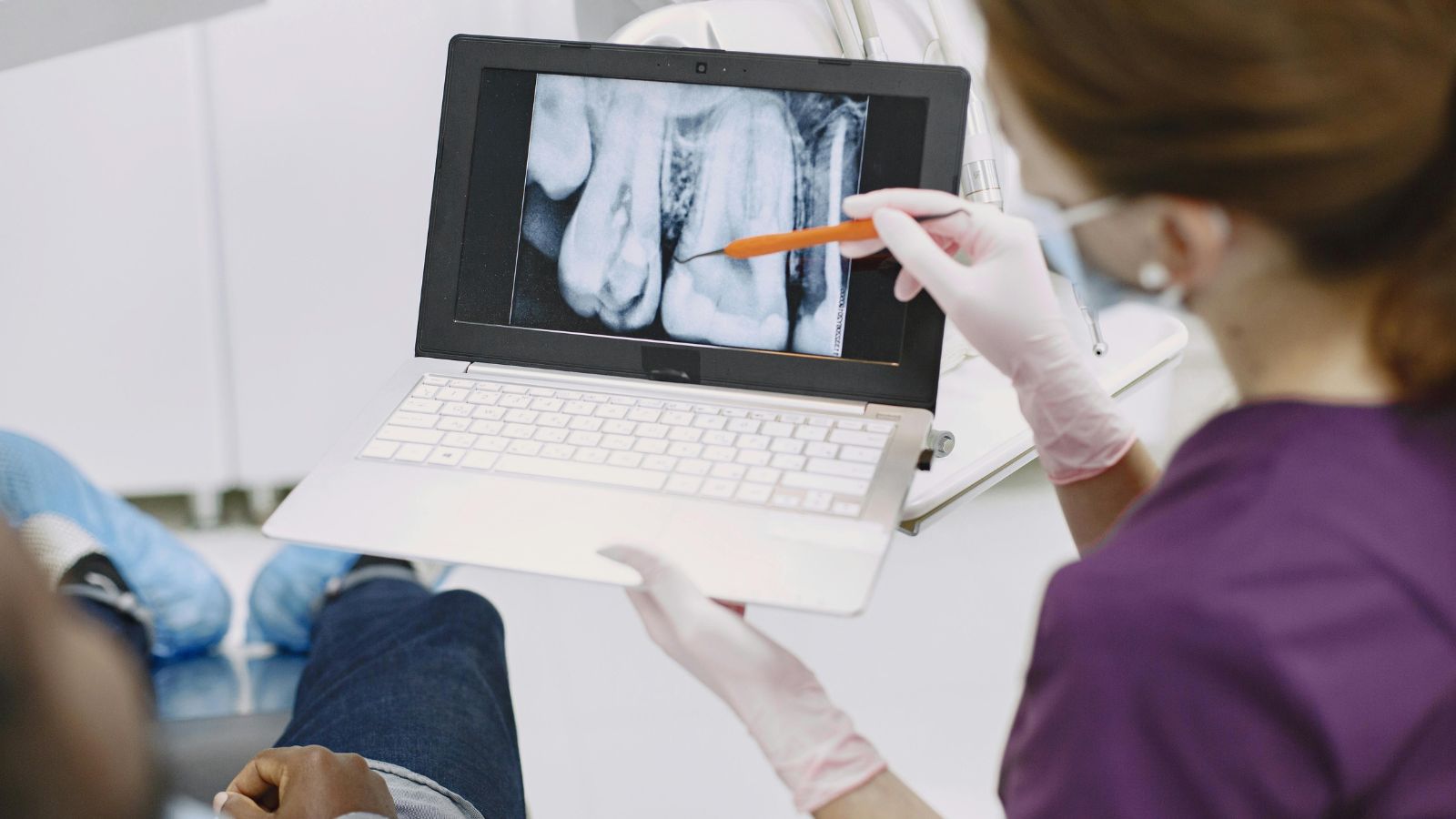
- Reading x-rays. Some tools mark spots on bitewing x-rays that may be early cavities, tartar or bone loss, so the dentist knows where to look closely.
- Tracking changes. Software can compare new x-rays with older ones to show whether something is growing or staying the same.
- Explaining findings. Marked-up images can make it easier for you to see what your dentist is pointing at.
- Office tasks. Booking, reminders, insurance forms and website chat tools may use AI.
How accurate is AI at finding cavities?
The research is promising but still early. A 2024 review of studies in the Japanese Dental Science Review found that AI picked up about 87 out of 100 cavities on bitewing x-rays and correctly ruled out about 89 out of 100 areas without decay.
It did better with deeper cavities than with very early ones in the outer enamel, about 84 versus 71 out of 100. The authors also noted that many of the studies had a high or unclear risk of bias and that only a few compared AI with dentists. They called for more testing in real clinics.
That is why AI works as a second set of eyes, not a final answer.
Does AI replace my dentist?
No. The Royal College of Dental Surgeons of Ontario (RCDSO) guidance on AI in dentistry says AI is not a substitute for a dentist’s clinical judgment. Dentists remain responsible for every decision about your care, and they must review what an AI tool produces before acting on it.
| What AI can help with | What your dentist still does |
|---|---|
| Flag possible cavities on x-rays | Examines your mouth and confirms what is there |
| Measure bone levels around teeth | Decides whether you need treatment and what kind |
| Compare x-rays over time | Explains your options, costs and risks |
| Send reminders and answer basic questions | Answers questions about your health and your care |
What are my rights when AI is used in my care?
The RCDSO guidance sets out what patients in Ontario can expect:
- You should be told when AI directly affects your care, and when you are talking to an AI tool such as a website chat.
- Your consent is needed before your health information is used in an AI tool or shared with another company.
- Your health information is protected under Ontario’s health privacy law (PHIPA).
- If you would rather limit AI in your care, your dentist should make reasonable efforts to accommodate you and note your concerns in your chart.
You can read more in the RCDSO’s questions and answers on artificial intelligence.
What this means for your next visit
Your visit still starts and ends with a person. Your dentist examines your teeth and gums, takes x-rays when they are needed, and explains what they see. If software helps along the way, you can ask what it does and how your information is handled.
If you are due for a checkup, see our family and general dentistry page, browse all our services, or contact our Richmond Hill office with any questions.
Questions patients ask
Can AI diagnose a cavity on its own?
No. AI can flag a spot that looks like a cavity, but your dentist examines you, reviews the x-ray and makes the diagnosis.
Is my health information safe if my dentist uses AI?
In Ontario, dentists must follow PHIPA and get your consent before your health information is used in an AI tool or shared with another company. You can ask who has access to it and where it is stored.
Can I ask my dentist not to use AI?
Yes. RCDSO guidance expects dentists to make reasonable efforts to accommodate patients who want little or no AI in their care.
Will AI find problems my dentist would miss?
Sometimes it can point out a small spot worth a second look. It can also flag things that turn out to be nothing, which is why your dentist checks every result.
Sources: RCDSO, Artificial Intelligence in Dentistry guidance; RCDSO, information on artificial intelligence; Japanese Dental Science Review, 2024, AI caries detection on bitewing x-rays.